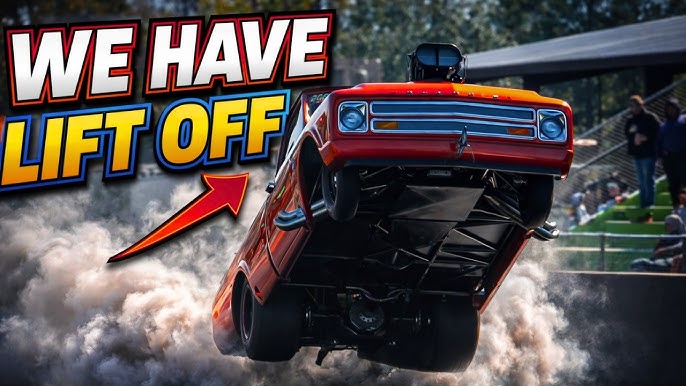
Check this, Goldstone Crashes Again at Sick Week Testing — But He’s Alright!

Sick Week is unforgiving. Long days, brutal conditions, and cars pushed well beyond their comfort zone make it one of the most demanding events in drag-and-drive racing. During recent Sick Week testing, that danger was on full display once again when Goldstone was involved in another on-track crash.
The good news—and the part that matters most—is simple: he’s alright.
Sick Week Testing: Where Limits Are Found the Hard Way
Testing for Sick Week is never casual. Racers don’t show up to “shake the car down.” They show up to find weaknesses before competition begins, because Sick Week punishes unprepared teams harder than almost any other event in drag racing.
Goldstone’s testing session followed that same philosophy—push the car hard, expose problems early, and deal with them now rather than mid-event.
Unfortunately, when limits are pushed, things can go wrong fast.
The Crash: Sudden, Violent, and Unforgiving
During a high-speed testing pass, Goldstone lost control, resulting in another heavy crash. These incidents happen in seconds, leaving little time for correction once the car steps out of line.
From the outside, crashes like this look chaotic—but they are often the result of razor-thin margins:
-
Aggressive tune-ups
-
Track conditions changing pass to pass
-
Suspension or chassis loading issues
-
Tire behavior under extreme power
In testing, racers accept these risks because discovering them early can save an entire week of racing later.
The Most Important Update: Goldstone Is Okay
What matters most is that Goldstone walked away. Safety equipment, chassis design, and track response did exactly what they’re supposed to do.
Modern drag racing safety measures—roll cages, fire systems, harnesses, and track crews—exist for moments like this. While the car can be repaired or rebuilt, driver health is non-negotiable.
In events as physically demanding as Sick Week, avoiding injury is already a win.
Damage Can Be Fixed — Lessons Are Priceless
While the crash will undoubtedly mean late nights and hard decisions for the team, testing incidents often provide critical data:
-
Where the car became unstable
-
How the suspension reacted under load
-
Whether tire choice or pressure played a role
-
What changes must be made before competition
Sick Week isn’t won by the fastest car on day one—it’s won by the car that survives all five days.
Crashes Are Part of the Drag-and-Drive Reality
Drag-and-drive racing is unique. Cars must:
-
Make extreme power
-
Survive repeated passes
-
Drive long highway miles
-
Be repaired with limited time and resources
That combination pushes teams into a narrow window where performance and survival overlap. Sometimes, that balance tips the wrong way.
Goldstone’s incident is a reminder of just how thin that line really is.
What This Means Moving Forward
With the driver okay, attention now turns to the car:
-
Can it be repaired in time?
-
Is the combination still viable for Sick Week?
-
Will the team dial things back or push forward?
These are the decisions that define drag-and-drive racers. Some teams retreat after a hit. Others rebuild overnight and come back stronger.
Final Thoughts: Tough Break, Strong Outcome
Crashes are never something to celebrate—but outcomes matter. Goldstone’s crash during Sick Week testing could have been far worse. Instead, it serves as another reminder of why preparation, safety, and experience are critical in this form of racing.
The car may be hurt. The schedule may be tighter. But the most important box is checked:
Goldstone is alright.
And at Sick Week, that means the story isn’t over yet.