Take a look at this, James Stevens Crash at 270mph, The Winternationals Nightmare That Shocked Drag Racing!

At over 270 mph, there is no margin for error. Every pass down the strip is a controlled explosion—precision, timing, and mechanical perfection all pushed to the limit. But when something goes wrong, it happens in a fraction of a second… and the consequences can be terrifying.
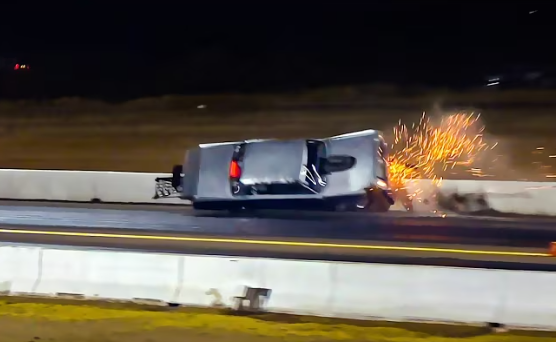
That’s exactly what unfolded during the Winternationals, when driver James Stevens experienced one of the most intense high-speed incidents seen in recent drag racing memory.
A Run That Turned Into Chaos
Everything looked routine as Stevens launched off the line. The car hooked hard, engines screaming, accelerating with brutal force down the strip.
But near the top end—where speeds exceed 270 mph—something went wrong.
Whether it was a mechanical failure, instability, or shutdown issue, the car suddenly lost control. At those speeds, even the smallest imbalance becomes catastrophic.
Within moments:
- The car veered off its line
- Components began to fail under extreme stress
- The situation escalated into a full-blown crash
The Danger of 270+ MPH Drag Racing
Top-level drag racing, especially in classes like Top Fuel, operates in one of the most dangerous environments in motorsport.
At 270+ mph:
- Drivers cover the length of the track in under 4 seconds
- Reaction time is nearly nonexistent
- Safety systems must work instantly—or not at all
Even with modern advancements—carbon fiber chassis, fire suppression systems, and parachutes—there’s no eliminating risk completely.
That’s what makes incidents like this so terrifying—and so real.
Fire, Impact, and Immediate Response
As the crash unfolded, the situation quickly intensified. High-speed incidents often involve:
- Fuel ignition
- Debris scatter
- Violent deceleration forces
Safety crews reacted immediately, rushing to the scene within seconds—something NHRA has refined over decades.
The response includes:
- Fire suppression teams
- Medical personnel on standby
- Rapid extraction protocols
These systems are the only reason many drivers walk away from crashes that look unsurvivable.
The Role of Safety in Modern Drag Racing
Crashes like this highlight how far safety has come in the National Hot Rod Association.
Key safety measures include:
- Shortened racing distance (1,000 ft) to reduce top-end speeds
- Advanced driver containment systems
- Multi-stage parachute deployment
- Fire-resistant suits and onboard extinguishers
Many of these improvements were implemented after past tragedies, reshaping the sport into what it is today.
A Stark Reminder of the Risks
The Stevens crash is more than just a shocking moment—it’s a reminder of the brutal reality behind drag racing.
Fans see:
- The flames
- The speed
- The adrenaline
But behind that spectacle is a constant battle against physics, where even the smallest failure can turn into disaster.
The Aftermath and What Comes Next
Incidents like this always lead to investigation and evaluation:
- Was it mechanical failure?
- Did a system fail at high speed?
- Could anything have prevented it?
NHRA and teams analyze every detail to improve safety and prevent future crashes.
For drivers, getting back behind the wheel after a crash like this takes more than skill—it takes courage.
Final Thoughts
The crash involving James Stevens at the Winternationals is a chilling reminder of what makes drag racing both thrilling and dangerous.
At 270 mph, there’s no room for mistakes.
And yet, drivers continue to push the limits—because that’s what drag racing has always been about.
Speed. Risk. And the relentless pursuit of going faster than ever before.