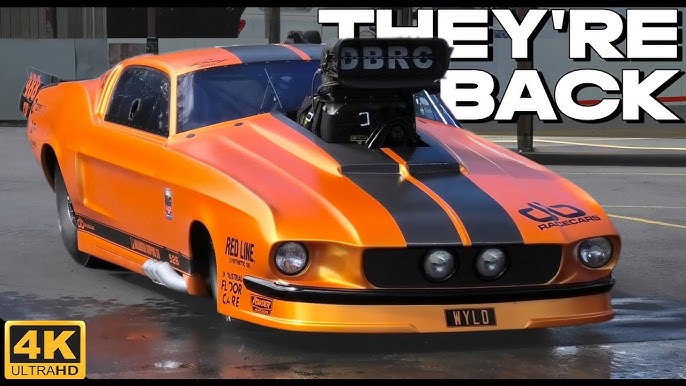
Take a look how Nate Sayler’s New Mustang Shocks the Field with 3.55 Pass at U.S. Street Nationals Testing!

When Nate Sayler rolled his brand-new Mustang into testing at the U.S. Street Nationals, expectations were high — but few anticipated just how fast this new combination would come around. After struggling to qualify at the Snowbird Outlaw Nationals, Sayler’s team quietly went to work. What followed was one of the most impressive turnaround stories of the early 2025 no-prep and radial racing season.
During testing, Sayler’s Mustang blasted off a stunning 3.55-second pass, instantly putting the Street Outlaws veteran back on every competitor’s radar.
A Fresh Build with Serious Intent
Nate Sayler, long regarded as one of the quickest and most technically skilled drivers in the No Prep Kings ranks, unveiled an entirely new Mustang powered by a ProLine MH8 Hemi with a screw blower — the first of its kind in competition.
At the Snowbird Outlaw Nationals, the new combination showed promise but lacked refinement. Early qualifying attempts hovered in the low-3.60 range, leaving Sayler outside the show. It was a frustrating debut, but not an unexpected one for a brand-new, high-power platform.
Instead of forcing the issue, the team focused on testing and incremental improvement.
Testing Pays Off: From 3.60s to 3.55
The breakthrough came quickly.
Just a week after Snowbirds, Sayler’s Mustang recorded a 3.58 pass during private testing, showing major gains in early power delivery and chassis efficiency. Then, during official testing ahead of the U.S. Street Nationals, the car laid down its best number yet:
-
3.55 elapsed time
-
9.09 sixty-foot
-
211 mph
-
Density altitude near 400 feet
In modern radial racing, those numbers are elite. A 9.09 sixty-foot on a screw-blown car signals exceptional chassis control, traction management, and tune-up precision.
The Power Package: Screw Blower vs. Hurst Charger
Sayler’s new setup is notable not only for its speed, but for its configuration.
Under current rules, screw-blown combinations face a disadvantage:
-
Heavier minimum weight (10 pounds more than Hurst-charged cars)
-
Overdrive capped at 92%, while Hurst chargers produce more power at similar settings
-
Less room to adjust mechanically within the rules
Despite these limitations, Sayler’s Mustang ran numbers competitive with — and in some cases better than — lighter, more favored combinations.
This performance strongly suggests that the ProLine MH8 screw-blown Hemi is producing exceptional torque and mid-track acceleration, even within regulatory constraints.
Driver, Tuner, and Setup: The Perfect Combination
Raw horsepower alone does not produce 3.55 passes.
The result reflects a balanced effort across the entire program:
-
Nate Sayler’s driving precision, particularly on marginal tracks
-
A refined chassis setup that now plants the tire aggressively without overpowering it
-
Expert tuning — believed to still be led by Lee White, one of the most respected tuners in radial racing
By the time the 3.55 flashed on the boards, it was clear: this car is now properly sorted.
From Non-Qualifier to Race Winner Threat
Just days earlier, Sayler failed to qualify.
Now, his Mustang has the pace not only to make the field — but to win events outright.
In a class where more than 70 cars are capable of qualifying, the margin between making the show and going home is razor thin. A consistent mid-3.50 car immediately places Sayler in the top tier of the field.
More importantly, the combination still appears to have room left in it.
What This Means for the U.S. Street Nationals and Beyond
With qualifying approaching, the competitive landscape has changed.
Several teams that struggled at Snowbirds have arrived better prepared, and qualifying is expected to be among the tightest of the season. But Sayler now enters the weekend with:
-
Proven top-end performance
-
Strong early numbers
-
A reliable baseline tune
-
And growing confidence in the new platform
If conditions remain favorable, Nate Sayler’s Mustang could easily qualify near the top — and become one of the most dangerous cars in eliminations.
Final Thoughts
In modern no-prep and radial racing, speed alone is not enough. Adaptation, development, and execution separate winners from spectators.
Nate Sayler’s rapid transformation from non-qualifier to 3.55 performer is a textbook example of elite-level race program management.
If this is only the beginning, the Street Outlaws veteran may soon remind the entire field why he has long been considered one of the most technically complete racers in the game.