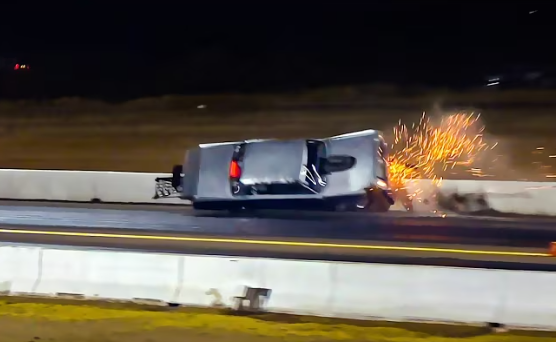
This is The Tragic NHRA Crash That Changed Drag Racing Forever!

The world of drag racing has always lived on the edge of speed and danger. But few moments in NHRA history hit as hard as the fatal crash that forced the sport — and motorsports safety worldwide — to evolve.
In the realm of high-speed drag racing, tragic crashes aren’t just moments of heartbreak; they are turning points that redefine safety standards and engineering philosophy. One such incident — the fatal wreck of Darrell Russell in 2004 — stands as a pivotal event that reshaped NHRA safety protocols and influenced innovations that still protect drivers today.
The Crash That Shook NHRA — Who Was Darrell Russell?
Darrell Russell was a highly respected Top Fuel driver competing at the elite level of NHRA drag racing. During the second round of eliminations at an NHRA national event in June 2004, Russell’s car suffered a catastrophic failure just past the finish line.
During the run:
-
A rear tire blew out, causing debris to fly and destabilize the car.
-
Shrapnel from the damaged components entered the cockpit area.
-
Russell suffered fatal injuries despite wearing approved safety gear.
The crash served as the first fatality at an NHRA national event since the loss of Blaine Johnson in 1996, underscoring how even the best safety standards of the day could be overwhelmed by high-speed failures.
How the Crash Changed Drag Racing Forever
Russell’s accident directly led NHRA officials and vehicle engineers to introduce several significant safety improvements, including:
1. Titanium Shields and Driver Protection
In the wake of Russell’s fatal injuries from flying debris, NHRA mandated a 2 mm thick titanium shield behind the driver’s head to block internal shrapnel in future incidents.
2. Fuel and Tire Safety Revisions
-
Goodyear worked with NHRA to produce a stronger, more puncture-resistant race tire compound to reduce explosive failures.
-
Minimum tire pressures were enforced to ensure predictable tire behavior in Top Fuel cars.
3. Aerodynamic and Fuel Limits
To reduce the lethal potential of run-offs and instability:
-
NHRA lowered maximum nitromethane content from 90 % to 85 %, which reduced peak power levels.
-
Top Fuel wing angles were limited to reduce dangerous downforce at high speeds.
These changes didn’t just make cars safer — they created new engineering benchmarks that became standard practice across drag racing internationally.
The Bigger Picture: Safety Through Tragedy
While Russell’s crash was a defining moment, it wasn’t the only wreck that pushed NHRA to rethink safety. Decades earlier, Blaine Johnson’s 1996 fatal crash at the Indianapolis U.S. Nationals became another watershed moment. Johnson’s engine explosion mid-run, loss of aerodynamic integrity, and subsequent collision with a guardrail highlighted the fragility of dragster safety at 300 mph speeds.
Both crashes underscored that even with roll cages, fire suits, and helmets, the high-energy physics of Top Fuel racing demanded better protective systems — ultimately leading to mandatory advances in chassis design, cockpit protection, and safety equipment still in use today.
Tragedy and Innovation — How Safety Keeps Evolving
In the NHRA, safety advancements often arrive as a response to loss — a painful but powerful incentive that pushes engineers and organizers to think beyond performance. Other tragic events over the years have similarly driven change, such as:
-
The development of fire suppression systems after career-ending burns in other racing series.
-
Roll bar padding mandates and chassis improvements following fatal injuries from internal impacts in barrier crashes.
While no safety innovation can ever fully eliminate risk, every rule change, every reinforced component, and every new protective layer is part of a legacy written by those who pushed the limits — and sometimes paid the highest price.
A Legacy Beyond the Finish Line
The fatal crash that changed drag racing forever — exemplified by Darrell Russell’s loss — forced the NHRA and the broader motorsports community to confront the brutal reality of racing at the edge of physics. It was a moment of sorrow that sparked innovation and ultimately made the sport safer for generations of drivers that followed.
Modern drag racing now features some of the most advanced safety engineering in motorsports history — a testament not only to human ingenuity but also to the courage of those who raced with heart and spirit until the very end.